Showing posts with label Neoliberal. Show all posts

Monday, 18 December 2017

The Alternative Year: It's the little victories that keep us moving forward

Twenty Seventeen was... a year. While 2016 was always going to be tough act to follow, 2017 really did it's darnedest - and it was certainly eventful. Sequels are always difficult, but last year had turned many people numb.

But a lot that happened in 2017 that was important - and some of it was even positive. So here's our breakdown of four of the big political themes in Britain, Europe and around the world this year as The Alternative covered them - and a fifth point, in spirit of the season, looking forward.

I. Election of Opportunity

Theresa May wanted to cement seven years of Tory government with the certainty of five more years with a majority and saw an opening when polls put her a long way out front. Luckily for anyone sick to their teeth with the Tories, the election didn't go the way she thought it would.

The unnecessary election backfired. Theresa May survived the blow but it very nearly knocked her out of 10 Downing Street. Over the campaign, Corbyn's Labour made up a staggering amount of ground and proved it could win. The rhetoric had been wrong, the Corbyn brand was electable.

Theresa May, now without a majority, clung on to power with a coalition deal with the DUP - the Democratic Unionist Party, of Northern Ireland. Gone were the frills of the manifesto and in was a billion in extra funding for Northern Ireland.

Facing her in May and June was a resurgent Labour, led by Jeremy Corbyn who was found to be more at home on the campaign trail than under the spotlights. But May also faced a patched up, locally-led, progressive alliance.

It wasn't the scale of cooperation that some hoped for (The Alternative, for instance), but it was a remarkable step that made a difference in a few of close battles. As a trial run, it showed promise for what alliance might achieve in the future.

Between Corbyn and the Progressive Alliance, it showed that the left had found how to win. But it was a beginning that needs an end. It's a job that needs finishing.

'General Election 2017: The Alternative guide to a critical general election for Britain'; in The Alternative; 8 May 2017.


II. The Far Right Returns

Photograph: Bundestag by Hernán Piñera in 2011 (License)
And the left learning how to win again could not come at a better time, because the far right is back. It had been creeping up for years. UKIP. Brexit. That President. Cracks were appearing and the far right was beginning to slip itself through them. The presence of a far right party in the German Bundestag was only the latest warning.

In 2017, the far right began to win seats in European parliaments in earnest. And yet, everywhere they fell short of power. The far right failed to make the breakthroughs it was hoping for - despite apparently hefty backing from Russia, which was finally called out by leaders in Berlin and in Westminster.

In the Netherlands, in France, in Germany and in Britain, far right parties have not been able to breach a barrier at around 13% of the vote. For all the rhetoric of a 'far right surge', they're a long way from convincing the people of Europe to turn back the clock.

In these defeats of the far right, centrists and progressives were left with feelings of relief - and often proclaimed them loudly. But there is no future in that feeling. Progressives need real reasons for optimism, based on good ideas that take hold in the public imagination.

'Relief as Far Right falls short in Dutch election, but there's no future in that feeling: Progressives need reasons for optimism'; in The Alternative; 20 March 2017.


'What next for Merkel and Germany?'; in The Alternative; 25 September 2017.

III. Neoliberalism Hanging On

Photograph: Emmanuel Macron campaign poster 'Macron President' in Paris by Lorie Shaull (License) (Cropped)
So far, the fact that far right has fallen short of power has been claimed as a victory for a certain kind of centrism and it's neoliberal hegemony - particularly in the case of President of France Emmanuel Macron.

But the yellow tide is not what it seems. Neoliberals are still winning the way they did in the 90s - by lethargy. With no better option, neoliberalism will continues to be the bitter pill that is accepted.

Neoliberalism is getting and staying in power aided by abstention as disinterest prevails and because the far right remains just repulsive enough that people are not persuaded by populist nationalism.

If neoliberal leaders are a bulwark, then they're a mossen edifice - an wooden post stood amid turbulent seas, sheltering a small pool of stagnant waters. It is the job of progressives to use the, relative, calm that this to come up with better ideas.

'The Yellow Tide isn't what it seems: The neoliberal centre has depended upon abstention and prevails amid disinterest'; in The Alternative; 10 July 2017.


IV. Seven Years of Tory Government

Photograph: Theresa May in Estonia in September 2017, by Arno Mikkor/EU2017EE (License)
It seemed that when Theresa May took over, she was at least willing to acknowledge that raw austerity thinking was hurting rather than helping. She voiced her belief in the Unionism of Joseph Chamberlain and promised a shared society - social harmony with a square deal for those who mucked in.

There has been little evidence of it in policy and the facts tell a sorry story about the state of Britain. While the government scapegoats anyone it can find, lives are becoming precarious and uncertain. Vulnerable people are squeezed of their benefits and poverty, including child poverty, is rising.

Poverty, real despair and destitution, has returned to visibility on the streets of the Britain. Only this week, in the run up to Christmas, are exposes being run on just how widespread poverty is - even among the working people Tories call the 'deserving'.

A fundamental component of the social contract has been broken by the Conservatives. Even with their heinous rhetoric towards the poor, that tries to draw lines between the deserving and undeserving, they at least maintain the semblance of offering a square deal in return for work. So where is it?

Work is precarious and poorly paid. Homes are expensive and even renting is getting out of reach. Prices of even basic goods are rising faster than wages. Personal debts are getting higher. The poor - those considered by Tories deserving and undeserving alike - are paying a heavy toll for realisation of the Conservative vision. Where is the fair deal?

'Unionism: What is Mrs May pitching?'; in The Alternative; 16 January 2017.


V. Little Victories

Changing things for the better, in the long run will not be the result of grandstanding. It will be hard fought and hard won, by thousands of people on a thousand issues, little victories that add up to a much bigger sense of momentum.

At times, the forces arrayed against progress can seem overwhelming. But for progressives, it's how things have always been. All we can do is pitch in. Start small. Begin by making the little differences that are within our reach.

There have been small victories in 2017. For instance, in Barcelona the municipal government began fining energy companies for cutting off the supply to vulnerable households. It's a small change. But it could make a practical difference and in communities across Europe, there will be stories like this. Little actions that, together, can build into a bigger change of the tide.

At the end of our "The Alternative Year" for 2016, we said that the lesson for 2017 was that social progressives remain the majority, their ideas can win, can engage and can empower. 2017 was a step forward on that road. Let's hope 2018 sees these truths lead to breakthroughs and, as ever, The Alternative be back in the New Year doing the best we can.

'Little Victories: Tackling energy costs would be a small win with big consequences'; in The Alternative; 21 August 2017.

Monday, 11 December 2017

Italian Left: Upheavals reveal progressive cross-section - struggle between pro-European current and rejection of neoliberalism. Can they be reconciled?

Matteo Renzi speaks in a university in October 2015. Photograph: Matteo Renzi a San Giobbe by the Università Ca' Foscari Venezia (License) (Cropped)
The Italian left is going through another of its upheavals, a common feature of politics in Italy over the last quarter century. There have been regular clashes and breakups over details and personalities. But this time, there may be a deeper root that can tell us something about the wider experience of progressive politics.

The Democrats as a Broad Front

Since the collapse of the centrist, statist, pentarchy - the five party system - in the 1990s, following the Mani Pulite investigation into political corruption that blew up into an engulfing scandal, the Italian left and centre has struggled to organise stable parties and coalitions.

At the centre of most efforts build a stable organisation of left and centre parties and supporters was Romano Prodi. He was a central figure in the movements La Margherita (The Daisy), L'Ulivo (The Olive Tree), and L'Unione. Prodi also played a central role in getting the broad and varied parties to agree to form the Partito Democratico.

The Democratic Party, the culmination of longstanding efforts to get the left to work together, eventually united most of those who might label themselves democrats - from democratic socialists to christian democrats, along with republicans, socialists, greens and progressive liberals.

But it seems to it wasn't to last. The present discord began with the leadership of Pier Luigi Bersani. From the old left of the movement, Bersani is a former member of the preceding Communist Party and the Democrats of the Left. When Bersani won the party leadership in 2009, it created a rift with centrist, liberal and christian democratic members of the party. They felt it confirmed the Democrats' drift leftwards and some decided to split away, to form new centrist parties.

Bersani, however, still won the primary for the Democrats' electoral coalition, 'Italia. Bene Comune' - which united both the mainstream Democrats and the green-socialist Sinistra Ecologia Liberta, 'Left Ecology Freedom'. Despite promising early polling numbers, the electoral list slipped back over the course of the campaign.

In the 2013 election, thanks to the electoral system, Bersani's Democrats took a narrow majority in the Chamber of Deputies, but the fell short in the Senate. The centre-right of Silvio Berlusconi regained ground and the anti-establishment, libertarian-right, Movimento 5 Stelle (Five Star Movement) showed surprising strength. In fact, the Democrats only achieved second-most votes among individual parties, behind Grillo's M5S

A tense period followed in which Bersani tried to find common ground with this new presence in the Italian Parliament - refusing to engage with Berlusconi and the right. However, Bersani's efforts failed. When a President failed to be elected, thanks in part to his own movement failing to agree on a candidate - with even Romano Prodi unable to gain general support - Bersani resigned his leadership.

Rise, Fall and Rise of the Renziani

Since 2013, the Democrats have been through several leaders and Prime Ministers. The resignation of Bersani had cleared the way for the centrist candidate of choice, Mayor of Florence Matteo Renzi - who had been compared to Tony Blair. Renzi's leadership, and Premiership, lasted three years.

During that time it was the turn of the left of the party to drift away, as Renzi held to the course of an unrepentant social democrat of the new style, embracing neoliberalism and adapting to it. That meant implementing measures to meet European Union and Eurozone conditions, in particular 'labour reforms' - the relaxing of employment laws to make hiring and firing easier, that have been deeply unpopular on the left, across Europe.

However, Renzi brought about his own, as it would turn out temporary, downfall with the constitutional referendum held last winter. Seeking to change the electoral system to reflect that of Germany, Renzi staked his leadership on the referendum. This was a gamble that Matteo Renzi lost.

With defeat, Renzi resigned the Premiership. He also resigned the party leadership, but announced his intention to run again. This announcement drove many on the left - socialists, democratic socialists, and even social democrats of strong feeling and other progressives who wish to reject the neoliberal system - to break away from the Democrats. That included party grandees like Bersani and Massimo D'Alema.

Renzi took back the party leadership with a resounding victory. But that has just created a new problem. While Renzi now had control of the Democrats - with a clear Renziani politics that is pro-European, liberal and centrist - he has few external allies.

The leftist groups that broke away formed a series of parties - Movimento Democratico e Progressista (MDP, social democratic), Possibile (progressive), and Campo Progressista (CP, democratic socialist) - that have refused to form an electoral alliance with the Renziani Democrats for the election next year. Instead, along with Sinistra Italiana (SI, democratic socialist), these new parties are organising a new alliance called Liberi e Uguali (LeU/LE), or 'Free and Equal', with the intention to stand against the Democrats as a left alternative option next year.

With left cooperation rejected, Renzi is pursuing the path of Emmanuel Macron, driving the Democrats in the direction of pro-European liberals and will have to pitch for new allies among centre parties - like Piu Europa (+Europa, PE), 'More Europe', that includes Emma Bonino's Italian Radicals.

Cross-section of the Left

This fragmentation, this new unwillingness, exposes a cross-section of the Left that is becoming apparent - and not just in Italy. On the one hand, there is a growing call to ditch neoliberalism. On the other, a strong pro-European sentiment - particularly among young people.

The search for unity and success for the left in Italy led to the assembly of a party out of a great many movements, with a great many ideological commitments. A way was found to find peace between social democrats, social liberals, democratic socialists, greens and even christian democrats.

That has now come apart over a split in priorities between rejecting neoliberalism and supporting the European Union.

Progressives need to wake up to the reality that these are not mutually opposed. They can be reconciled. But to do so means finding a way to reform Europe - to rebuild and renew the Social Europe, in line with democratic principles.

We need to reform Europe, to pursue a continent with a strong social chapter at it's heart. But the first step is learning to cooperate anew. Progressives of different strands in Italy found ways to work together. They, and progressives everywhere, need to do the same now.

Monday, 10 July 2017

The Yellow Tide isn't what it seems: The neoliberal centre has depended upon abstention and prevails amid disinterest

Macron's landslide was not quite what it appeared, exposing how neoliberal Centrism depends upon disinterest and abstention. Photograph: Emmanuel Macron campaign poster 'Macron President' in Paris by Lorie Shaull (License) (Cropped)
The rise of Macron was met with a chorus of celebration from some corners for the resurgence of the 'Centre'. In France, we are to believe, the neoliberal Centre has recovered. But has the centre really found a new revitalising note?

In the presidential election, Macron prevailed as the neoliberal Centrist candidate thanks to a number of factors: the collapse of social democracy, repeated Centre-Right scandals, and because the Far-Right was sufficiently repulsive.

Now, even with the Left non-committal, Macron did secure the support of around 45% of registered voters in the head-to-head with the Far Right. But was the high water mark.

At the legislative elections Macron's party, La Republic En Marche, took a landslide majority. Yet it came amid a low turnout. While his party took 49% of second round votes, just 43% of voters turned out - giving them the support of only about 20% of eligible voters.

The neoliberal Centre is holding on to power, but it doesn't seem to be the result of its own arguments. If anything, it seems as if the Centrists are standing still as the turbulent waters wash around them. As protest votes and popular dissensions of the Left and the Right ebb and flow, the stagnant Centre appears to rise or fall.

Just look at Italy. Despite losing a crucial referendum in December and resigning as Prime Minister, Matteo Renzi won back the leadership of the Partito Democratico in a landslide. And judging from the polls, he will likely return as Premier at the next election.

If he does, it would be explicitly at the head of a party of Renziani Centrists and neoliberals, looking to replicate Macron's success. That comes thanks to the Left-wing of the party going through with its threat to leave if Renzi won back the leadership.

Under former party leaders Pierluigi Bersani and Massimo D'Alema, the Centre-Left walked away to work towards concentrating all of the many Left factions - including their own Democratici e Progressisti vehicle - under a single progressive banner.

This move leaves Renzi as the undisputed leader of a definitively Centrist party. Matteo Renzi again proves himself to be - in the years of turmoil created by Berlusconi finally, if only partially, falling from grace - pretty much the last man standing.

But what else does Renzi have? Other that his political skill that earned him the nickname 'il Rottamore' - the scrapper. He lost the constitutional referendum on which he staked his Premiership and the Renziani approach has alienated the Centre-Left and driven them out of the party - much as the Hollande governments did and Macron risks doing with his programme.

Furthermore, it was his political skill - not electoral success - that saw him rise to the position of Premier, after a succession of resignations when the Democrats under Bersani failed to gain enough support to govern with it's Centre-Left platform in 2013.

While the Democrats had consistently polled well under Renzi, up on 2013, their lead has slipped and the recent turmoil has seen them fall into a neck and neck race with the populist anti-establishment party Movimento 5 Stella (M5S).

The sum of this is that in Italy, the 'third way' Centrism - blending social democracy and neoliberalism - may return to power with Renzi, but it's unlikely to do so with sweeping triumph. Again, the waters are moving and the Centrists are not the ones moving them.

In the Netherlands, Prime Minister Mark Rutte celebrated his party remaining the largest and the halting of the Far-Right advance. But the figures tell a different story. Between the coalition partners - the Centre-Right liberal-conservative VVD and the Dutch Labour Party PdvA - they lost 37 seats and 24% of the vote.

For Rutte's VVD, it was the failure of an alternative to muster sufficient support from a fractured and plural political landscape that has kept him in power: they remained the largest party with just 21% of the vote.

It will take an across the spectrum alliance of at least four parties to keep Rutte's VVD in office. While that kind of pluralism is a positive thing, it's not exactly evidence of a great Centre revival.

In Britain, the failure of the Liberal Democrats to increase their share of the vote reinforced the point.

By succeeding in getting people to engage with politics, to turnout and vote, Jeremy Corbyn shut down what appears to be the main avenue along which the neoliberal Centre has travelled: abstention.

If this is the case, it makes the pitch made by the Lib Dems over the last few elections and the New Labourite obsession misguided. Pitching to be the party of faceless bureaucrats, the party of government, the party of business, only seems to work if people have lost interest.

Could a new British party of the centre have done better than the Lib Dems? A party of economically neoliberal social democrats, uniting Labour MPs with some liberals and even some Tories, and pitching to as broad a base as possible, under a leader like Yvette Cooper?

The numbers don't really support it. Even with the Tories and Labour getting their largest vote share for some time, abstention was still the largest block. The reality is that Centrism doesn't seem to have a convincing story to tell and so stands still as events move around it.

Macron was the rallying point to see off a threat. And while Justin Trudeau did indeed lead the Liberals to a huge comeback and landslide majority in Canada in 2015, he did so with the support of just a quarter of eligible voters - the gift of an electoral system - against the waning power of an ever more rightward leaning government.

If Renzi wins back to the Premiership in Italy with effective power, it will also be likely thanks to an electoral system. And, in the Netherlands, Rutte held on thanks to support being fractured across the plural options.

While the Right rallies an angry minority around a crude nationalism that makes wild promises and the Left assembles behind a hopeful interventionism, the Centre mostly benefits from disengagement. The the relative recovery of the Centre comes to look more like a holding pattern.

This isn't the sign of a recovery - it's the absence of one.

The Centre remains with a hand on power because disengagement remains a real issue and neither a Left Alternative nor the angry Far Right have, so far, won over enough support with the broader public.

While this does seem to toll the bell for neoliberalism, Centrism need not necessarily follow it. There is a place for Centrism, but right now it seems like the Centre is struggling to understand itself.

The Centre is supposed to be about balance. About inclusion. That is not the same thing as 'equidistance'. And the occupation of the centre ground by neoliberalism is more about 'received wisdom', the present consensus, than the ideals of the Centre.

In a pluralist society, Centrism has an important role to play. It pursues a stake in society for people on all sides and tries to maximise the utility of the society - to ensure the maximum number of people enjoy the benefits.

What that can't mean is accepting conservative narratives on the economy, the trap that the heirs of New Labour have frequently fallen into. That centrism, of neoliberalism, has become like a technical government, a bureaucratic caretaker while we await something better.

Those that values the ideal of the Centre - inclusion - need to wake up. The revival of the Centre is not what it appears. The politics of management is offering nothing and standing still. People are ready to move. Centrists need an answer as to where.

Monday, 16 January 2017

Unionism: What is Mrs May pitching?

Unionism was Joseph Chamberlain's special province when he dominated Victorian politics. Today, Theresa May is trying to spark a resurgence. Photograph: Joseph Chamberlain plaque by Simon Harriyott (License) (Cropped)
At the beginning of last week, Theresa May launched her first full year as the leader of the Conservative & Unionist Party with a speech that called for a 'shared society' (BBC, 2017). Over the years, the Conservatives have made many rebranding attempts. Is May's any different?

For the most part, the attempts of her predecessors - Major, Hague, Duncan Smith and Cameron - have been focussed on repackaging Thatcher. They have tried to soften the harsh anti-government and anti-interventionism tone to the policies of the Thatcher-Reagan consensus (BBC, 2017{2}).

But they all contained the same disdain for the idea of a 'society' as a figment created to justify collectivism - to justify a claim that people have duties towards others beyond themselves and their own families, expressed through taxation and the state. They just tried to make rejection of the state, and embrace of the free market and privatisation in its place, palatable or 'empowering'.

May's rebrand seems different. She has appealed harder to the idea of the state's role, promising intervention in a way that none of her recent forebears would perhaps have contemplated. She has hinted at moving away from austerity and letting the state intervene more. But how does this all relate to what we know of conservatism and do these appeals follow through?

Chamberlain and Unionism

Theresa May's inspiration, it seems, for this deviation from the legacy of Thatcher is Joseph Chamberlain. Chamberlain was the Victorian political heavyweight who broke his Unionists away from the Liberals and led them into alliance, and eventual merger, with the Conservatives.

A businessman, and industrialist, he was at first aligned with the radical liberal reformers who campaigned for enfranchisement and free, compulsory - and local authority run - education. As Mayor of Birmingham he reorganised municipal utilities, bringing them under municipal control, cleared slums, and rallied public and private money to public works, such as building libraries, museums, schools and parks.

On the other hand, he proved himself to be an aggressive nationalist. He opposed Irish Home Rule and defended the Union, and further wanted to see the Empire become a truly, exclusively, British trading system, protected by trade tariffs and was willing to back military action to advance Britain's interests - in ventures not so far removed from the interventions of the neoliberal governments in oil rich countries in the early 2000s.

The Unionists, of which he was a leading figure, where a strange coalition of aristocratic Whigs with landed estates, who as a faction were drifting away from the Liberal mainstream, and a group of radical reformers led by Chamberlain. These two groups were united mostly by their opposition to Irish Home Rule, which would break up the Union.

The composition of the Unionists shifted over time, but it settled around a particular outlook: a British nationalism that transcended its constituent nationalities, built upon institutions like Westminster government, and preserved the Union; and, economic intervention at home with a protected British system of trade abroad, directed to British interests alone.

But what was perhaps most significant, from where Theresa May sit, was that the Unionists brought a working class base to the Conservative coalition. Chamberlain's personal support, centred on Birmingham, included working class voters, gave the traditional party of the landed aristocracy a broad enough base of followers to dominate government in the twentieth century.

May and Unionism

May's first conference as leader was at Birmingham, the centre of her hero's political empire and was the scene for the first two big moves of her ministry: to disentangle a still United Britain entirely from continental entanglements and to prioritise some spending over paying down the deficit (BBC, 2016; BBC, 2016{2}).

And there have been other moves. Intervening to delay Hinckley Point, alleged promises made to Nissan that speak of protectionism, hints of economic planning in the promises to develop an industrial strategy, and the continuance of the Conservative policy of devolution to the local government level that could have pleased Chamberlain (Goodall, 2016).

However - and it is a big, emphatic, however - no Conservative leader has been scared to use central government, top down, intervention when it suited them; privatisations continue; part of the Brexit rhetoric is that Britain is leaving the EU in search of freer trade, not more protected; and devolution has been hand in hand with cuts, as a way to impose austerity while handing off responsibility for its results.

Without a tangible set of policies to mark her approach out as distinct, what part of the legacy of Unionism is May promoting? Well, so far, the main thrust of May's Unionism has been cultural. Her speeches focus heavily on acknowledging injustice (Kuenssberg, 2017) and warning that it will 'undermine the solidarity of our society' (May, 2017).

That word - 'solidarity' - seems like an odd choice of phrase for a Conservative in the modern era, but it might be understood better when coupled with her phrase 'bringing our country together', which is what May presents as her solution to the rising resentment.

That phrase makes clear that this isn't 'solidarity' in its usual collectivist democratic sense, of the people standing together for mutual empowerment - an egalitarian mass movement of people aiding each other as a counter the power of an elite class.

Rather, May's point - her Unionism - seems to be very conventionally conservative: the traditional institutions have broken down and people are lost without their place in the established order. To end resentment, May seems to be arguing that a Burkean social harmony must be restored.

In that, there seems to be marked a drift in the party away from liberal conservatism towards something more purely conservative. Since the decision to enter the Coalition, a reaction within the party has grown ever louder against Cameron's soft conservative neoliberalism. In its place, rises an effort to reconcile individualism and competition, with an appeal to nationalism and community coherence, to unite the two errant wings of the ideology.

It is in the prioritising of these first two, and neglect of the last two, from which May sees resentment springing - and it certainly seems to fit how resentment has been filtered through Farage and UKIP. What May also sees is an opportunity.

Chamberlain combined local social reform with banging the patriotic drum, pitching a British system that carried a sense of a nation and tradition in which ordinary people have a stake - where everyone has their part to play. May sees a chance, in evoking the Chamberlain heritage of Unionism, to bring working people into a Conservative coalition.

Society as seen through a Prism

To do this May has taken up the language of the Left, but filtered its cause through a conservative prism. For instance, she wants to equate social justice with social harmony - in the process stripping it of its sense of distributional equality, leaving behind only class collaboration and perhaps, in the conservative sense, a 'fair deal' on work and pay.

The trouble is that social harmony is illusory. It requires citizens to accept exclusion and inequality in exchange, maybe, for a place of safety and security within the fold. Meanwhile the true elite - the wealthy, the rentiers - do not need to give up or compromise much of anything to take up their place within the harmonious order.

"A Britain that works for everyone" is not a slogan that promises very much - just as "We're all in this together" proved an empty promise to ordinary citizens, their sacrifices unmatched by the elite. Unionism addresses resentment by falling back on nationalism, looking to 'the nation', 'the Union' and their institutions as a rallying point.

Chamberlain's own Unionist star fell when colonial adventures brought misery and his closed economy could not compete with the benefits of being open to the world. The reality is that his Unionism did not leave ordinary people better off, however much it rallied them about a patriotically waved flag. Theresa May is trying to pick up and claim that fallen standard.

Progressives should not be seduced. People cannot be content with a place within May's social hierarchy: tightly ordered, tightly surveilled - living under close control, in exchange for just the hope of a little basic social security. Unionism, and its social harmony within a hierarchy, offers citizens neither liberty or justice.

Monday, 12 December 2016

Working Poverty is appallingly high and social care is in a funding crisis - the 'Big Society' was a cloak stolen by a wolf

David Cameron deftly altered the image of the Conservatives and his success has left us with a society in crisis. Photograph: Prime Minister David Cameron - official photograph by Number 10 (License) (Cropped)
Under David Cameron and George Osborne, the Conservative Party worked hard to change its image. With Labour in power, and getting very comfortable within the establishment, they sought to present themselves as warm and compassionate with just a light fondness for tradition.

Part of that 'compassion' was to roll back the 'nanny state' - to stop big government looking over people's shoulders. The counterpoint was to instead get society, out of charitable and philanthropic instincts, to pull together and support each other in their own communities.

But the 'Big Society' disappeared quickly. But then it had already served its purpose, as the sheep's clothing for the wolf - just the latest in fashionable lines, taken from progressives, that the Right had shrouded itself in to slip unnoticed amongst the livestock.

And if anyone still believed in the Conservative vision, after years of austerity had stripped their community of libraries and investment in roads, schools and healthcare, and left social care in a near terminal crisis (Triggle, 2016), recent reports should dispel the illusion.

The most recent damning report is that of the Joseph Rowntree Foundation, which reported that seven million people in Britain suffer from working poverty (Joseph Rowntree Foundation, 2016). That means that, despite earning an income in work, these people are still unable to make ends meet.

More than any of the other reports, working poverty is the most damning betrayal of the promises of Conservatives, and of neoliberalism. The basic promise, that hard work will bring reward, that will people will gain on merit, has been broken.

Conservatives, neoliberals, the purveyors of 'free' markets and small government - they sell privatisation with a promise: with no government restraining or filtering, there will be innovation, and the entrepreneurial will be allowed to get ahead, to take what they are merited.

But the 'Big Society' brand, the promises of liberty, conceal a darker reality. They neatly package selfish individualism for sale by disguising what it brings with it: disconnect, loneliness and isolation. Consider that, even as work is delivering poor rewards, the job centres are facing closures (BBC, 2016).

As a demonstration of how much it is being put upon any one person to carry the weight of their own obstacles, the closure of job centres is illuminating. People are being cut off from one another, with little power or means to change their situation. Merit, it seems, requires an inheritance to get started.

Conservatives and neoliberals want to package this as 'liberty' and 'individualism', but that's only half of the story. Their liberty is negative liberty, believing only in removing barriers. What that won't address is the crushing inequality that goes untouched, except by charitable disposition - something that itself comes under attack by the deeply conservative notion of neoliberal individualism. How can charity flourish amidst an a conception of the individual that is hierarchical and dependent upon competition, selfishness and greed?

The impact of the neoliberal and conservative ideologies is destructive. They're reducing society to a mad scramble that turns communities first against each other, and then inwards upon themselves, as individuals must put aside their social bonds to pursue their own interests.

But in fighting that destructive impact, in undoing the pain caused by the neoliberal ideology, that glorifies selfishness, we mustn't give up or suppress individuality. In fact, it would be a sore loss to give over individuality to an ideology that reduces it to little more than greedy consumption and extraction.

Individuality can be so much more. Instead, a social fabric needs to be woven in which individuals live ever with the support and cooperation of others. Where people realise the fullness of themselves in collaboration with others, rather than competition with them. A positive liberty, that raises people up as well as removes the obstacles from their path.

Conservatism, as it represents the establishment, has ever kept itself relevant by gobbling up the language of progressives, turning the words of hope into tools for their own designs. Individuality becomes selfishness, community becomes sectarianism, the balance and moderation of civic republicanism becomes a 'centre' captured and dragged ever to the Right.

We have to stop handing sheep's clothing to the wolves. We have to stop letting conservatism take our words and twist them. Ideals, art and culture are created by and belong to the 99% - the 1% just exploits them for profit. We must fight for every word.

Monday, 14 November 2016

What to expect from President Trump? To see how an opportunist backed by the far right will fare in government, look no further than Italy's Silvio Berlusconi

Silvio Berlusconi, through controversies and legal battles, held the position of Prime Minister in Italy for nine years out of seventeen on the political frontline. Photograph: Silvio Berlusconi by paz.ca (License) (Cropped)
If progressives are going to start building a meaningful opposition to the global rise of far right populism, seen most recently in the Trump Presidential Campaign, they first need to understand what they will be standing against. What will the representatives of the far right pursue when actually in office?

When considering what to expect, its important to look to history. For Trump in particular, there are obvious comparisons to Ronald Reagan (Rich, 2016) - though, it seems, except for those who really buy into the Myth of Reagan but don't like Trump, and so want to distance the two as much as possible.

But perhaps a better guide for expectations, both for Trump and beyond, might be the rise of Silvio Berlusconi in Italy in the early 1990s, out of the wreckage of the Italian political system that imploded with the exposure of  huge corruption under the Mani Pulite investigation.

Amidst massive political disillusionment and a global downturn, a seeming outsider, with business credentials, and in alliance with parties of the far right, put themselves forward as the champion of the populist opposition to the corrupt old establishment - despite plenty of their own legal battles, to which their support seems immune.

Sound familiar? Trump's rise mirrors Berlusconi's own route to power. The media chief, and chairman of football club AC Milan, began his long relationship with political power in Italy at the head of his party Forza Italia - named for a popular football chant.

If that does not say enough, as a measure of the man consider that Berlusconi once claimed, with extravagant outrage, that one of his longest running political opponents, Romano Prodi, called him a drunk during a 2006 election debate - and offered him a "no, you are" in return (Popham, 2006). What Prodi had actually said was:
"He uses statistics like a drunk uses lamp-posts, more for support than illumination."
For those who want decency and reason in the political arena, this level of obfuscating outrage is infuriating. When a political candidate is willing to twist anything, to play whatever role happens to be convenient to the relevant situation, coherency be damned, it makes it impossible to get to grips with what that candidate actually believes - and so to have a meaningful political exchange.

But whether that was what he actually believes is besides the point. What that exchange presented was an opportunity. And the seizing of such opportunities defined Berlusconi's career - as it does Trump's as well.

Silvio Berlusconi rose to power on the back of a career as a media personality, a celebrity, just as much as he did on his career in business. His media company took on the establishment and broke through the state owned monopoly on broadcasting - though in part thanks to his connections in that very same government establishment.

And when that - again, very same - government establishment collapsed amidst one of the biggest political corruption scandals ever seen, Berlusconi took to the political field - despite his own connections and the spreading of investigations into his own businesses (The Economist, 2001).

Berlusconi promised to keep Italy pro-Western and pro-Market, create a million new jobs and protect the country from the communists - the Italian Communist Party successor, the Democrats of the Left, were virtually the last party standing in the Italian political system after the corruption scandal.

The coalition he put together to achieve those promises - with the separatist Lega Nord in the North and the post-fascist Alleanza Nazionale in the South - backed by a massive publicity campaign on his own TV channels, received the most votes and seats in the 1994 Italian general election.

His first government collapsed after only nine months, torn apart by its own internal contradictions. Yet, though often with only a tenuous grip, Berlusconi returned to power time after time, with rebuilt coalitions that pushed the same mix of social conservatism and economic neoliberalism.

And he was never far from controversy. Berlusconi was accused of being sexism in Italy's most powerful apologist, as his personal life often spilling over into the political and even sparking protests (Marshall, 2016). His legal troubles also followed him constantly.

The same kinds of fate are now being predicted for Trump's Administration, as he tries to marry his misogynist and nativist support with the Republican mainstream - itself a contradictory collections of libertarians and nativist Christian nationalists.

Just as legal scandals chased Berlusconi throughout his career, they're likely also to follow Trump. With numerous cases still outstanding against him, some commentators are even predicting that Trump may ultimately end up being impeached by the Republican-controlled Congress (Oppenheim, 2016).

The election of Trump answered one question to which the answer was already known: that negative campaigning is used because it works - even, it seems, in its most extreme forms. It also drew parallels between Trump and Berlusconi, that suggest that far right populism is unlikely to hurt the Reagan-esque tax-cutting, laissez-faire, pro-business establishment.

But what about about in Europe, where far right parties have pushed their way into the mainstream with fewer compromises and mainstream alliances? As with Trump, promises of social conservatism, anti-immigration and harsh law and order policies have abounded. Yet on economic policy, the stances of far right movements have been inconsistent.

Trump's one elaborated economic policy was for a massive tax cut. That matches up with UKIP's policies, which have historically leaned toward less compromising version of Conservative manifestos, with tax cuts, especially for those at the top and large amounts of deregulation.

Yet while Trump has hinted at protectionism, it has been more strongly pushed in Europe. For instance, Front National have travelled over time from aggressively, anti-welfare, 'parasite' opposing, Reagan neoliberals, to ardent advocates of state control and protectionism (Shields, 2007).

Other far right parties in Europe, such as the Freedom Party of Austria and the Party for Freedom of the Netherlands, or elements of the Five Star Movement in Italy, have expressed a kind of national liberalism, to which the French Front National seems aligned.

The parties are standing, ostensibly, to 'protect' their 'national values', which have over time extended to include liberal tolerance, particularly of native homosexual and Jewish communities; and attempted to reconcile what amounts to 'national welfare', claiming to expel outsiders from the system, with the neoliberal capitalist system.

These positions express profound contradictions: between the rousing of intolerance and promises of social protection, and between deep connections to the low tax, low regulation and big business neoliberal order and promises of economic protection.

Berlusconi showed that these contradictions can be maintained, though not without difficulty and obvious fragility, over a long political career. So whichever way these parties break, caught between intolerant, nationalist and statist demands and their neoliberal connections, progressives need to have a strong argument that counters the flaws of both. And that argument needs to bring together radicals and moderates, democrats and liberals.

Justice, Liberty and Progress; equality, cooperation and sustainability; these values drive progressives. The far right stands opposed to them, picking and choosing between them as it suits their cause. Progressives need to unite around them - whether against neoliberalism or nationalism, as both are disastrous.

Petty squabbles are the opportunities that the Berlusconis and Trumps exploit. They disillusion the public and open the doors to opportunists and extremists. That pattern needs to end, in the name supporting those made most vulnerable by the rise of such forces: women, minorities, refugees, immigrants and the impoverished.

Friday, 15 January 2016

In Argentina, Macri's broad Centre coalition secured the Presidency. Yet the question remains: when can the Left cut ties with neoliberals to pursue truly radical reforms?

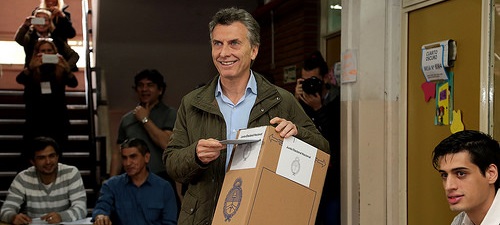
Mauricio Macri, pictured casting his vote in the August primaries, united the Centre-Right and Centre-Left opposition to defeat the Kirchner candidate and become the first non-Peronist, non-UCR President. Photograph: Mauricio Macri vota by Mauricio Macri (License) (Cropped)
After twelve years in power, the Kirchnerist faction of the Peronist movement, in the form of the Partido Justicialista, lost their grip on the Presidency of Argentina (Watts & Goni, 2015). In the second round of voting Mauricio Macri, leading the broad centre coalition Cambiemos, defeated the Justicialista, and former President Cristina Fernandez de Kirchner, backed Frente para la Victoria candidate Daniel Scioli (BBC, 2015).

Macri's victory has been received positively as, possibly, the beginning for a new moderate Argentina (Cottle, 2015). And yet, while neoliberals, in particular, rejoice in a pro-market victory, Macri's Presidency has only come with the complicity of the centre-left, specifically the Union Civica Radicale (UCR, Radical Civic Union).

That tentative alliance raises the question of whether, sooner or later, those with Left-wing tendencies, particularly within UCR, will feel the need to go their own way - though there is a lot of work ahead before a progressive slate could win without some sort of agreement with, or against, the Peronist movement.

Not the least consideration is that the election of the conservative liberal Mauricio Macri will not, alone, be enough to change the direction of Argentina. Although, the defeat of Kirchner's populist Peronist candidate - which has brought a positive response from neoliberal pro-market voices - has been regarded as a new turn for Argentina and, possibly a little optimistically, the overthrow of populism (Rodriguez-Brizuela, 2015).

While the Peronists are still the largest group in the Congress, that may shift over the course of Macri's term as half of the Chamber of Deputies is elected every two years in legislative elections. And the efforts already launched by Macri at tackling Argentina's immense economic challenges have received praise (The Economist, 2016). So, for the moment, the momentum is with Macri.

However, Macri's support came from a coalition primarily divided between the Centre-Right party Propuesta Republicana (Republican Proposal, PRO) and the Centre-Left party Union Civica Radical - backed by a mix of supporters from across the centre (The Argentina Independent, 2015). So what of Macri's Radical partners?

Despite the party's name, the UCR is a moderate centre-left party, seen by the harder Left as bourgeois, that has for decades been caught between other factions. The traditional opponents of the Peronists, some internal and breakaway factions such as the Radicales K have nonetheless found themselves sometimes allies with Peronist factions, in pursuit of reforms that promise social justice and improvements to the lives of citizens (La Nacion, 2006).

Yet the authoritarian character of the Justicialista - with fears ranging from electoral fraud to intimidation and suppression of the press, along with policies like the confiscation of pension funds to plug financial holes (Marty, 2015; Crandall, 2012) - seems to have helped align the UCR with the opposition. That has led the UCR on the path joining Cambiemos, despite its mainstream, globalising, neoliberal approach (Rodriguez, 2015).

Now, it would not be a surprise to see the election of 2015 presented as a contest between the market and the state. Yet in reality, it was more after the fashion of the statist, populist and nationalist Peronists, holding a long-term authoritarian grip on power, versus a broad opposition, that Macri has succeeded in rallying around his open and 'neoliberal' way - that embraces the global system.

That is a story replicated across Europe in different shades - liberals and social democrats shackled to the neoliberal mainstream, in the face of rising fear and nationalism, rallying to protect positive gains embodied in the the establishment institutions. So why, the question might well be asked, would or should the Centre-Left consider breaking away from the Centre-Right? It is certainly clear that the global economic crisis is not over and that populist nationalism has not retreated - even in Argentina after its defeat.

The answer is because, ultimately, neoliberalism is no friend to social progress.

For all his moderate liberal credentials, as Mayor of Buenos Aires Mauricio Macri behaved in a typically neoliberal way - defunding social programs in search of competition at the expense of social security (Esperanza Casullo, 2015). And Argentina's Macrinomic path out of its present crisis will likely follow the same austerian path as many countries in Europe - particularly the UK under George Osborne Chancellorship.

But that doesn't mean that some overnight, clean break is imminent. Progressives in Argentina must build gradually towards an unshackling, because the election demonstrated that there is not yet much of a political space for a radical alternative to Peronist statism or the neoliberal market. Yet Macri's election has levered open the door and progressives must step into that new space to develop a fresh consensus around a just, sustainable and liberating alternative, amenable to the building of broad Left movement.

Wednesday, 4 November 2015

Can Guy Verhofstadt's four steps to reforming the state help bring together progressives of all stripes?

In July, Guy Verhofstadt outlined to Alexis Tsipras the steps he believed where necessary to reform the state. Photograph: Press Conference from ALDE Communication (License) (Cropped)
Guy Verhofstadt, leader of the Liberal caucus in the European Parliament, was amongst those to congratulate Justin Trudeau on his party's victory in the Canadian general election. The former Prime Minister of Belgium praised the inspiring example set by the Liberal Party of Canada's positive campaign (Verhofstadt, 2015).

Trudeau's team sought to rise above their opponents' negative campaigning and pledged investment in much needed infrastructure - with the promised benefit of stimulating the economy - and to pursue progressive policies like a positive climate change policy, taking the pro-choice side of the abortion debate, and seeking to heal the wounds from internal conflict over indigenous rights (Hays, 2015; Phipps, 2015).

It is unsurprising that Europe's liberals would be looking for the lessons they can learn from the success of their counterparts in North America. In the European Union, liberals govern in only 7 countries, their European Parliament group holds only 9% of seats, and in countries like Germany and the UK the long established liberal parties have faced electoral wipeouts over the last five years.

Yet the elections in Canada - as well as elections in Argentina, Poland and elsewhere over the past week - confirm one thing very clearly. Overcoming the Conservative establishment and fending off the efforts of Right-wing populists to assume control, isn't something that one progressive faction alone can accomplish.

Relying on the distorting effect of electoral systems that force voters into unrepresentative concentrations, or hitching the party wagon to a popular carthorse, cannot be considered lasting strategies. In what is clearly a pluralistic and divided political arena, the alternative has to be the building of alliances - and that means finding common cause between liberals and democrats, socialists and radicals, that can hash out what it means to be progressive in opposition to conservatism.

Back in July, Guy Verhofstadt used a visit by Prime Minister of Greece Alexis Tsipras to the European Parliament to challenge the Syriza leader on the need for political reform in Greece (ALDE Group, 2015) - a confrontation that was at least softened with support for finding a solution to the government of Greece's need for serious debt relief.

In his speech, Verhofstadt laid out a series of reforms Tsipras would be required to take if Greece was going to get the support it needs. Condensed into four steps, they were:
  • Bring an end to clientelism & establishment privileges,
  • Downsize the public sector,
  • Privatise public banks, and
  • Open up employment to give young people access.
If these four steps can be taken to represent a condensed version of the reforming aims of modern liberalism, how do they match up with the aims of other progressives?

In Greece, Tsipras and the Radical Left Syriza party have been struggling under stringent fiscal and economic conditions to press on with reforms (Hope, 2015). Tsipras choice to accept Eurozone terms for a further 'memorandum' bailout, to get access to the funds to continue reforms, even caused a split in his party that saw first Yanis Varoufakis and then later the Left faction of his party leave (Farrer, Rankin & Traynor, 2015; Henley & Traynor, 2015).

In his efforts to find a solution to the recurring crises, Alexis Tsipras' pragmatic radicalism has seen the Prime Minister of Greece drifting into the same political territory as that occupied by Prime Minister of Italy, and Partito Democratico leader, Matteo Renzi.

In Italy, Renzi has faced many of the same problems as Tsipras: unemployment, particularly amongst young people; clientelism and corruption; and a public and private sector heavily intertwined (Kramer, 2015). His approach has been to try to work within neoliberal models and play by its rules - a big centrist democrat legacy of Tony Blair (Day, 2014). That has required the pursuit of "competitiveness", including making labour more "flexible" - meaning making the cost of business cheaper, by making the cost and permanency of labour cheaper and weaker (EurActiv, 2014).

In the run-up to the UK general election in May, BBC Economics Editor Robert Peston described Ed Miliband as in the mould of Margaret Thatcher in his attempt to react to the times, and the debts held by the state, to tried to find solutions that did not involve the state being in control or ownership (Peston, 2015). In seeking decentralised solutions, Miliband was crossing into traditional liberal territory, but he struggled to sell them or inspire support with them

With Jeremy Corbyn taking over the helm of the Labour Party there have been fears of a sharp shift towards state ownership. Yet the ideas of the his economic advisory council are fundamentally mainstream and his 'renationalisation' plans have been more about co-operative public ownership than state control (Cortes, 2015).

In Greece, Italy and the UK, economic conditions are forcing parties of the Left to look for solutions that would certainly fall within two of Verhofstadt's recommendations: to downsize the public sector and privatise public banks. The question then becomes whether progressive parties can find an economic approach broadly acceptable to all sides.

As for political reforms, the situation looks trickier. In the UK, support for electoral reform towards something more proportional and bringing an end to an unelected Lords is growing, but is far from certain. In Italy, proposed political and constitutional reforms remain controversial in their attempts to strengthen the executive over the legislative (Politi, 2015), while Italy, and Greece, remain in an ongoing struggle to tackle corruption.

With regards to youth unemployment, in both Italy and Greece, tackling that specific problem seems a long way away as both countries grapple with the broader crisis (Totaro & Vasarri, 2015; Howden & Baboulias, 2015). In the UK, the Conservative government is pursuing apprenticeships as its go to measure, a pledge matched by the Labour Party during the election campaign (Wintour, 2015).

The need to find broad agreement across the Centre and Left is hastened by the dangerous rise of populism in the hands of deeply sectarian factions and moved along by popular nationalism and popular traditionalism (Roubini, 2015). Critics of conservative populism call for a Keynesian response that boosts aggregate demand with job creation and economic growth, that reduces income inequality and increases opportunities for the young.

To achieve these goals, a way has to be found to overcome the problem of social democratic/liberal positions having become toxic and to embrace the fact that people want something more. There is a general progressive hope, expressed through protests and activism, for a grander vision that focusses less on ambition and wealth, and more on cooperation and on what kind of life, and what kind of opportunities, there can be.

Elements of Guy Verhofstadt's proposed reforms being found in the work of other government's of the Left across Europe, even under huge fiscal burdens, certainly shows that some sort of bridge can be built between the positions of moderate and radical progressives, whether democrats or liberals, to offer a positive progressive alternative to conservatism, nationalism and populism.

But these are only the broad strokes and far more progressive things can be achieved. The next step has to be to embrace movements like Yanis Varoufakis' "very simple, but radical, idea" to build a cross-party EU democracy movement (Varoufakis & Sakalis, 2015). In such movements there is a chance to find common ground in pursuit of reform for the common good.

Monday, 26 October 2015

What can progressives learn from elections around the world?

Progressives have struggled in recent years to get their distinct narratives heard over the cry of populist nationalism. Photograph: Argentina Elections posters from 2013 by Beatrice Murch (License) (Cropped)
On Sunday there where general elections in two countries separated by eight thousand miles, including two half continents and an ocean. Yet they both told a similar story. In neither Argentina nor Poland was there a revival of the Centre-Left like that which brought Justin Trudeau to office in Canada.

In Argentina, the populist and nationalist Justicialist Party, of outgoing President Cristina Fernandez de Kirchner, had nearest competitors who were fiscal conservatives, ruling party dissenters, and small state neoliberal capitalists. In Poland, that contest was reversed, with the neoliberals in power and the populist nationalists as the main opposition.

In both cases, the populist and nationalist parties were victorious. For the Left, that serves as a stark reminder that there are many places where the progressive voice remains quiet in opposition to populist nationalism, or where centre-left collapsed during the seemingly global discrediting of social democracy and has yet to be rebuilt (Lawson, 2011; Guinan, 2013).

General elections in Argentina

In Argentina, President Kirchner had reached her term limit and so her successor Daniel Scioli was leading their populist coalition Frente para la Victoria (FpV, Front for Victory), dominated by their Peronist Justicialist Party (PJ, Partido Justicialista), into the election. Their main opposition was the broad centrist coalition Cambiemos (Let's Change), featuring Presidential candidate Mauricio Macri's Centre-Right Propuesta Republicana (PRO, Republican Proposal) and Centre-Left Union Civica Radical (UCR, Radical Civic Union). The third major group were the conservative UNA, Unidos por una Nueva Alternativa (United for a New Alternative), a dissenting faction of the ruling Justicialists.

In the Presidential primaries, Front for Victory took 38% of the vote, while Cambienos took 30% and the UNA took 20% (Hodari, 2015). FpV and Cambienos had 8 and 12 senate seats at stake, respectively (with the Radical Civic Union alone holding 7 of them), while the majority of the 130 lower house seats at stake were Justicialist, in total 84, with only 21 from Cambienos (again, the Radical Civic Union alone holding 13 of them).

These parties and coalitions went into an election with the national economy facing escalating inflation and stagnant wages, with a slow recovery from high unemployment on uncertain ground. The election was also mired in scandals, with fears of electoral fraud and intimidation, and somewhat unsettling outbursts from Scioli accusing social network users of plots to damage his image.

Observers had expressed exasperation at the impact of Peronist populism remaining strong, with its nationalists and crowd pleasing facets, for its obstruction of a much more serious debate (Lampa, 2015). Criticism was levelled at the parties only drawing vagaries between the centrist's Cambiemos' more neoliberal approach, toned down to fiscal responsibility, and the populist FpV's centralised state intervention.

The election itself produced a recognisable situation: a country divided multiple ways between several parties. In the Presidential election, there was no clear winner with FpV's Scioli and Cambiemos' Macri both claiming around 35%, with the UNA candidate Massa claiming 21%, which will have to be settled in a run-off in a month's time (Davies, 2015). In the Senate and the House of Representatives, the indications where that there would be more division, with FpV increasing its upper house seats but losing overall control of the lower house (Watts & Goni, 2015).

General elections in Poland

In Poland a similar situation had evolved where one essentially conservative party ruled with others as their primary opposition. Yet in Poland, the situation was slightly reversed. The ruling party where the neoliberal Civic Platform party and the opposition where the populist, nationalist, Eurosceptic, anti-immigration and anti-abortion  Law and Justice party (Nardelli, 2015).

Despite eight years in government and having steered the country through the economic crisis with relative calm, in comparison to other European countries, polling and a loss in the Presidential election in May showed that the Civic Platform party was losing support - falling from 39% at the last election to 25%. For progressives that would have been welcomed as part of the rising tide of support for the radical Left or the recovery of the Centre-Left.

Yet the Presidential election was won, not by the Left, but by the hard-Right Law and Justice party (The Guardian, 2015). That party took 30% at the last election but had risen in the polls to 36%. Meanwhile, efforts to assemble a United Left group to contest the election have only managed to gather around 9% in the polls.

When the exit polls where released, it became apparent that the shift from the Centre-Right to the hard-Right in Poland was in fact being undersold by polling data. Law and Justice were set to take 39% and enough seats to govern alone of the vote while their Centre-Right opponents had fallen even further to 24% (BBC, 2015).

Even more remarkable was that the exit polls suggested the complete failure of a parties of the Left to gain even a single seat. The United Left electoral alliance appear to have fallen short the 8% lower threshold (Cienski, 2015).

Progressives still haven't found their voice

In both countries, the full official results are still coming in. Yet what is clear is that elections in neither Argentina nor Poland have shown the strong progressive movements that the Left in other countries, like Canada and Portugal (Evans-Pritchard, 2015), have tapped into. The progressives parties that do play a prominent role, such as Argentina's Radical Civic Union, find themselves caught up in a politics polarised between conservative electoral factions that are split only over state intervention and whether they should pursue big state or small state conservatism.

Both elections serve as a stark reminder that the Left has still not found a convincing answer to popular nationalism. In the UK, Ed Miliband, under the influence of Blue Labour, simply tried to mimic it so as to steal it away from conservatives. Yet nationalism, and appeals to popular power, remain difficult subjects for the Left. Progressives are at once drawn to popular movements - to protests, marches and popular organisation - and critical of the dangers of suppression of the individual and irrationality inherent to them. The Left is also often seduced by the cohesion and commonality of national pride, even as it undermines internationalist humanitarian ideals.

If progressives are going to compete with and defeat conservatism - and the political divisions apparent across the world say it is very possible, whether it is popular, traditional or economic conservatism - they must build a convincing approach founded in co-operation and pluralism. Those are the characteristics by which the Left stands truly apart from the Right and progressives need to be brave in making the case for them, regardless of how much better nationalism may play with the crowd.