Showing posts with label Cambiemos. Show all posts

Monday, 13 November 2017

Argentina midterms raise the question: What's so funny about compassionate realism?

Mauricio Macri's hold on La Casa Rosada lightly reinforced by small gains at the Argentina legislative midterms. Photograph: La Casa Rosada from Pixabay (License) (Cropped)
The midterm elections in Argentina did little to settle the future of Argentina. President Mauricio Macri's movement gained a few seats, just enough to keep his project rolling forward.

That Macri's project is essentially austerity in a more extreme context is important for progressives to consider. It presents the epitome of what the Centre-Right consider the justification for strong dose of 'realism', but raises the question of why that has to be delivered in the form of harsh measures?

The Midterms elections covered a third of the Senate and half of the lower House. It would have been hoped by Cambiemos to be an opportunity to reinforce Macri's presidency with a stronger legislative contingent - just 16 of 72 in the Senate, with just 86 Deputies out of 257 in the Chamber, to around 46 and 105 for various Justicialist groups combined, respectively.

The four biggest parties each had about half of seats their Chamber seats up for reelection, while most of the Senate seats were being defended by Justicialists (Peronists).

As it happened Cambiemos made gains, though they were few. The coalition took 19 seats, not enough reach a majority, while those were offset by the 25 seats gained by former President Cristina Fernandez de Kirchner, rallying voters from various populist parties to her particular faction.

Even if this result is more than Macri and Cambiemos might have feared, it is still less than they will have hoped. Part of the reason why may be that, after two years in office, Macri has yet to deliver a deep sea shift in the country's economic condition.

That shouldn't really be a massive surprise, because two years is nothing. But the public are restless and what Macri has asked for is a huge change in approach from the Kirchnerist-Peronist years.

Not least are the cuts to subsidies that help with the cost of living for low income families. This is the austerity programme familiar to many progressives around the world.

In Argentina this has particular significance. In reason years, at the least, the Kirchnerist-Peronist populists - especially under the presidency of Cristina Fernandez de Kirchner - have tended to offer up big promises, comfortable lies to package harder truths and deeper crises.

Of relevance to all of those resisting austerity is the response of Centre-Right, Argentina as elsewhere: to serve up cold reality and a cold shoulder.

The Cambiemos coalition, that Macri has serving up a meagre helping, includes most of Argentina's Centre and Soft Left - social democrats and social liberals - and you have to wonder have these partners feel about their direction.

Macri has bet the house on austerity, in the meantime putting the poorest in some jeopardy, gambling that foreign private investors will step in and take a chance on Argentina. But it's yet to pan out that way.

The midterms buy Macri some space. Over that past year he has poured the blame for the present situation on the Kirchner "K" movement - calling it the "K Inheritance", probably fairly. But that approach will only work for so long.

Cristina Fernandez de Kirchner is already building for a comeback, taking seats at the midterms while Macri's approval ratings hover dangerously low at 41%/46% (approve/disapprove).

Macri has offered some consolation to his Cambiemos partners. Last year he announced what he called a 'Marshall Plan' - a reference to the huge public investment made by the US government in it's allies after World War II.

In reality, it was a public-private investment initiative foucsed on lowering the cost of business - in that conservative vein of reduced costs hopefully leading to reduced prices and reduced cost of living.

But these pledges are coming alongside efforts to force Trade Unions and dockworkers to accept pro-competition measures - and while cornered, they are far from convinced.

All of this leads back to the central question. Populists offer an unrealistic view smothered in giveaways and the Right demand a reaction steeped in a cold austere reality. The question is, why can't we address reality with warmth?

Why is it so difficult to imagine a compassionate realism? To pursue a course that does not abandon the most vulnerable to the mercy of corporate interests and charity, when righting a sinking ship.

Politics in Argentina is raising this question. Progressives and their allies the world over need to find a way to respond.

Friday, 15 January 2016

In Argentina, Macri's broad Centre coalition secured the Presidency. Yet the question remains: when can the Left cut ties with neoliberals to pursue truly radical reforms?

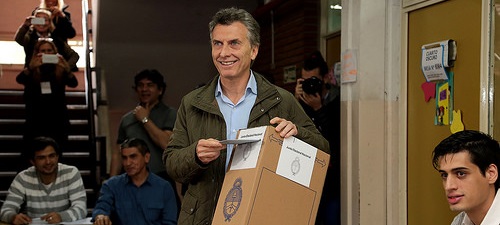
Mauricio Macri, pictured casting his vote in the August primaries, united the Centre-Right and Centre-Left opposition to defeat the Kirchner candidate and become the first non-Peronist, non-UCR President. Photograph: Mauricio Macri vota by Mauricio Macri (License) (Cropped)
After twelve years in power, the Kirchnerist faction of the Peronist movement, in the form of the Partido Justicialista, lost their grip on the Presidency of Argentina (Watts & Goni, 2015). In the second round of voting Mauricio Macri, leading the broad centre coalition Cambiemos, defeated the Justicialista, and former President Cristina Fernandez de Kirchner, backed Frente para la Victoria candidate Daniel Scioli (BBC, 2015).

Macri's victory has been received positively as, possibly, the beginning for a new moderate Argentina (Cottle, 2015). And yet, while neoliberals, in particular, rejoice in a pro-market victory, Macri's Presidency has only come with the complicity of the centre-left, specifically the Union Civica Radicale (UCR, Radical Civic Union).

That tentative alliance raises the question of whether, sooner or later, those with Left-wing tendencies, particularly within UCR, will feel the need to go their own way - though there is a lot of work ahead before a progressive slate could win without some sort of agreement with, or against, the Peronist movement.

Not the least consideration is that the election of the conservative liberal Mauricio Macri will not, alone, be enough to change the direction of Argentina. Although, the defeat of Kirchner's populist Peronist candidate - which has brought a positive response from neoliberal pro-market voices - has been regarded as a new turn for Argentina and, possibly a little optimistically, the overthrow of populism (Rodriguez-Brizuela, 2015).

While the Peronists are still the largest group in the Congress, that may shift over the course of Macri's term as half of the Chamber of Deputies is elected every two years in legislative elections. And the efforts already launched by Macri at tackling Argentina's immense economic challenges have received praise (The Economist, 2016). So, for the moment, the momentum is with Macri.

However, Macri's support came from a coalition primarily divided between the Centre-Right party Propuesta Republicana (Republican Proposal, PRO) and the Centre-Left party Union Civica Radical - backed by a mix of supporters from across the centre (The Argentina Independent, 2015). So what of Macri's Radical partners?

Despite the party's name, the UCR is a moderate centre-left party, seen by the harder Left as bourgeois, that has for decades been caught between other factions. The traditional opponents of the Peronists, some internal and breakaway factions such as the Radicales K have nonetheless found themselves sometimes allies with Peronist factions, in pursuit of reforms that promise social justice and improvements to the lives of citizens (La Nacion, 2006).

Yet the authoritarian character of the Justicialista - with fears ranging from electoral fraud to intimidation and suppression of the press, along with policies like the confiscation of pension funds to plug financial holes (Marty, 2015; Crandall, 2012) - seems to have helped align the UCR with the opposition. That has led the UCR on the path joining Cambiemos, despite its mainstream, globalising, neoliberal approach (Rodriguez, 2015).

Now, it would not be a surprise to see the election of 2015 presented as a contest between the market and the state. Yet in reality, it was more after the fashion of the statist, populist and nationalist Peronists, holding a long-term authoritarian grip on power, versus a broad opposition, that Macri has succeeded in rallying around his open and 'neoliberal' way - that embraces the global system.

That is a story replicated across Europe in different shades - liberals and social democrats shackled to the neoliberal mainstream, in the face of rising fear and nationalism, rallying to protect positive gains embodied in the the establishment institutions. So why, the question might well be asked, would or should the Centre-Left consider breaking away from the Centre-Right? It is certainly clear that the global economic crisis is not over and that populist nationalism has not retreated - even in Argentina after its defeat.

The answer is because, ultimately, neoliberalism is no friend to social progress.

For all his moderate liberal credentials, as Mayor of Buenos Aires Mauricio Macri behaved in a typically neoliberal way - defunding social programs in search of competition at the expense of social security (Esperanza Casullo, 2015). And Argentina's Macrinomic path out of its present crisis will likely follow the same austerian path as many countries in Europe - particularly the UK under George Osborne Chancellorship.

But that doesn't mean that some overnight, clean break is imminent. Progressives in Argentina must build gradually towards an unshackling, because the election demonstrated that there is not yet much of a political space for a radical alternative to Peronist statism or the neoliberal market. Yet Macri's election has levered open the door and progressives must step into that new space to develop a fresh consensus around a just, sustainable and liberating alternative, amenable to the building of broad Left movement.