Showing posts with label Sadiq Khan. Show all posts

Monday, 30 April 2018

Local Elections 2018 Preview: Labour look set for gains, but what we need more is a greater diversity of perspectives

Manchester City Council, with 95 Labour councillors and 1 Liberal Democrat, is a prime example of the need for a greater diversity of unwhipped perspectives in local government. Photograph: Manchester Town Hall by Stephen Douglas (Licence)
After last year's opportunistic election did not go to plan for Theresa May's Conservative and Unionist Party, her government - propped up by the Northern Irish loyalist Democratic Unionist Party - has been stumbling from one potential crisis to another.

These elections come at a strange time. Despite both main parties struggling, they both remain at around 40% in the polls and have a strangling grip on local government. Is this a chance for smaller parties to make some breakthroughs on councils?

With the majoritarian two-party system reasserting itself, some pushback from smaller parties like the Greens or Lib Dems would be welcome, to ensure representation of a wider set of perspectives - and to increase the accountability of local councils.

Conservatives

This will be the Tories first big electoral test since then. The final totals will need to weighed against the fact that half of the seats up for re-election are currently held by Labour. Yet there could be some headline defeats for the government.

Theresa May's party is particularly at risk of losing council seats in London. This includes control of Wandsworth, their flagship council from the time of Margaret Thatcher, which was used as the pioneer for contracting out local services.

The Conservative have taken a low key approach to the local elections. This may be a result of their own strategists projecting heavy losses to Labour. Downing St may have accepted that and prepared to downplay the significance.

This hasn't stopped local Conservative branches from pursuing aggressive campaigning tactics - including repeating the racist and Islamophobic overtones of the Goldsmith campaign for Mayor of London, which targetted Sadiq Khan's ethnicity and religion.

This time around there has been condemnation from Tory voices. But is the Conservative establishment distancing itself simply because of the timing? Local councillors have said their leaflets were signed off by Conservative HQ.

Mired by the Windrush scandal - entirely of their own creation - and with the media pursuing Labour hard over antisemitism, did the Tories just find it an inconvenient moment to be pursuing openly divisive tactics themselves?

Labour

With Labour holding most of the council seats up for grabs this time around, the party has to make inroads in Conservative areas. Part of that has them focussing very heavily on London - perhaps sensing that there are big headlines to be written.

Key Conservative controlled areas could be vulnerable to Labour and sweeping gains - on a night when they will begin already in a dominant position - will be an emphatic statement that can be milked for publicity and be used to continue the narrative of a Labour Party on the ascent.

For the Labour Party leadership, that would be a much need boost as their forward momentum has been arrested - despite the Tories creating problems for themselves - by their inability to adequately address the issue of antisemitism.

The media and critics have run roughshod over Labour on the issue, and Corbyn and his team have not come up with a way to convincingly show that antisemitism will not be tolerated - and thus diffuse the issue. As a result, a cloud hangs over the party.

So too does the ever looming prospect of a split. It's hard to see how anyone on the opposition benches would benefit, in the short term, from an inamicable split - even though a split increasingly seems like a good idea, to end the spiteful internal squabbling.

A split is hindered however, by the archaic quirks of our electoral system, that does not abide multiple parties and the increase in critical perspectives it can bring, nor the prospect of groups working together despite holding different membership cards.

Opposition

The Green Party laid out this, the big theme of the local elections, in the UK in their campaign launch. Co-leader Jon Bartley called for an end to Britain's "one-party state" local councils, to increase their transparency and accountability to local people.

It's an argument that thinktank Compass and it's chair Neal Lawson also press, stressing that Labour need to overcome their obsession with claiming a monopoly on power - which leads it to absorb or crush any possible rivals, rather than working with them.

In terms of the Green Party's own prospects, their best hope may be in trying to make inroads into Labour dominated councils, whose unchallenged authority has resulted in some poor outcomes - that have left some voters disaffected. Consider, for example, the goings-on under Labour at Haringey or Sheffield.

The other visible party of opposition in local government are the Liberal Democrats. Buoyed perhaps by their consistent - as usual - good form in council by-elections, they've been talking up their chances of a mini-revival at the local government level.

With the polls consistently putting the Conservatives and Labour neck and neck, 40% to 40%, it's difficult to see where the Lib Dems will make inroads - especially after several years of desperate defence, to hang on to what they hold.

As supporters of a Progressive Alliance, The Alternative wants the Lib Dems to refind their progressive side. But at present their best chance of picking up seats may be by, finally, convincing Conservative voters that what they liked about the Coalition was actually the Lib Dems all along.

So watch Lib-Con head-to-heads. This is a dynamic that could have a gigantic affect on a future election, where Lib Dems taking votes and seats directly from the Tories could tip Theresa May out of office and open the way for Labour.

Voter ID

These local elections will also be the first to trial the controversial new Voter ID measures that the Conservatives hope to roll out nationally. Such measures have been deeply criticised by electoral and rights groups.

The reality is that, first of all, Britain has very little in the way of electoral fraud, and second, that Voter ID does little to stop voter fraud. In fact, it does little but deter voters - discriminating particularly against the poor.

The trial runs will take place in Swindon, Gosport, Woking, Bromley, and Watford.

Municipalism

If we are to have effective local government there must be no barriers to participation for the community. Their representatives must be accountable and transparent, and able to hold local bodies to those same standards on the public behalf.

Erecting barriers, especially those disproportionately impacting voters from minority groups, and leaving one-party local councils unchallenged, is a recipe for bad governance. Well run, accountable local government can achieve so much at the municipal level.

There are big ideas out there, from Barcelona to Preston. Municipalism taking root. Local government can empower local people. The first step is to break up the local political monopolies, to leave them no choice but to start hearing criticism and engaging with it.

Monday, 15 August 2016

The headlines are dominated by the Labour Party, but the progressive movement goes on beyond its factional strife

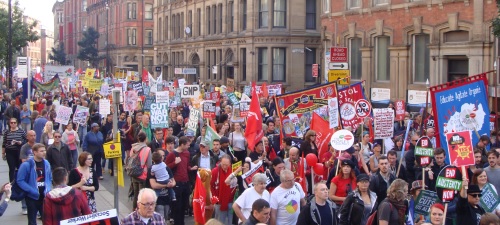
Progressive politics goes on, far beyond the limits of Labour and its grimly destructive leadership civil war. Photograph: Protesters outside last Autumn's Conservative Party Conference in Manchester.
The summer recess is usually the slow news time for British politics. This summer was supposed to be different. The two big parties, Labour and Conservative, side by side, would hold leadership races, setting the political agenda for the return to business in September. However, the Conservative race saw Theresa May blast away the field in short order.

That left the leadership challenge in the Labour Party to hold the spotlight all by itself. And that contest, with all of its chaos and rancour - including the party taking legal action against its own leader and even its own membership - has been a sour experience for progressives. To try and balance out the negativity of Labour's internal wrangling, here is a look at what other progressive party's and groups have been up to around Britain over the summer.

Sadiq Khan and London

In London, Sadiq Khan has set out early to establish himself in his new role as Mayor of London. One of his very first appearances was at London Pride - a strong progressive symbol with which to start his time in office. There will be arguments about his policies, but what Khan has gotten right, so far, has been image.

If there is anything with which the Left has traditionally struggled, and which can do so much to energise support for progressive policies, it is presenting a bright and positive vision. In Canada, Justin Trudeau led the Liberals back to power with a positive feeling campaign, and the image Khan's has projected bares much in the way of comparison - not least their appearances at Pride events.

On policy, the one issue that has stood out so far, and on which Khan has been particularly strident, is arguing for greater autonomy for the city. Part of the post-Brexit response, but also part of a movement emerging across Europe, Khan wants London to have more devolved powers to help is combat the predicted negatives resulting from leaving the European Union.

Khan has been making a determined push, post-Brexit, with his social media hashtag "#LondonIsOpen", getting celebrities and athletes on board in support. It seems to be the sum and central theme of Khan's start as Mayor: open to all people and open to business, everyone is welcome.

When talking of London, it is also worth mentioning the work of Take Back the City, a grassroots political and community organisation that aims to get directly to people in London's communities and make their voices heard. Amina Gichinga, a member of the group and London Assembly candidate, took part in the Progressive Alliance event in July. Gichinga made a strong and eloquent case, very much worth watching, for what needs to change in how politics is conducted in Britain.

Liberal Democrats

Meanwhile, the Liberal Democrats continue their rebuilding efforts. The party seems to have returned to what it did best, focussing on local and community politics. At the 2016 local elections, the Lib Dems made the most gains of any party and has since continued to win local elections with growing numbers.

But to restore the party's tarnished image is a much broader work. To that end, on the wider British scene, Tim Farron has been trying put the party to work fighting on key issues. One such issue was Brexit, on which Farron confirmed the Lib Dem commitment to Europe and aligned the party with the 48% who voted to stay.

Most recently, Farron has been critical of vague promises from the Treasury to match European Union funding in the near future. He has called for the government to show where the alleged £350m a week of funding will come from and demanded that long term reassurances be given to those who depend on it can make important long term decisions.

Various leading members of the party have also associated themselves with efforts to build cross-party cooperation. Vince Cable took part in the Progressive Alliance event, proposing an electoral pact come the next general election, and Paddy Ashdown is backing More United, an effort to promote crowdfunding of candidates on the basis of values rather than party allegiances.

That attitude to cooperation is reflected in Wales, where, now with just one Assembly Member, the Lib Dems have entered into Coalition government with Labour. Former leader Kirsty Williams took on the office of Education - and has stated absolute opposition, on behalf of Wales' Coalition, to the reintroduction of grammar schools.

Caroline Lucas and the Greens

Last, but not least, are the Greens. The Green Party as a whole has made small gains, but still haven't made the major breakthrough - on the verge of which they seem to have been for a decade. In Scotland, at the 2016 elections, the Greens moved into fourth place. Yet in London they merely retained their seats and in Wales got nowhere near the seats.

However, their sole MP Caroline Lucas has been amongst the most active and most visible of the Left's political figures and campaigners over the first half of the year. From her NHS Bill, to campaigning for cross-party cooperation and a Progressive Alliance; Lucas has been the most visible, perhaps bar Sadiq Khan, and certainly the most outspoken, coherent and unabashed leader - not in title but in deed - amongst progressives.

Punching far above the weight of her one seat out of six hundred and fifty, her loud advocacy for pluralism in politics has helped move forward the campaign for proportional representation and for cooperation between progressives. Lucas has announced that she will run again for the party leadership, a move that many may see as important to the party's near future development - considering her visibility and popularity.

Progress and Pluralism

The future of the Left depends on more than who is the Labour Party leader. That's a hard message to accept, particularly for those who feel the blows from the Conservative axe most weightily and fear that Labour is only party with a realistic shot at displacing the axe-swingers. But the party has used that fear as a way to gouge support for decades, while alienating potential supporters all the while and shutting down any plurality of debate.

The Left can be about more than just one, jealous, centralising party. The Left is a place of diversity: civil rights, equality, sustainability, justice, cooperation, feminism, democracy, liberalism, radicalism, the individual and the community - thousands of voices with thousands of issues. Trying to force them all into one tent, to represent them all with one voice, hasn't worked and won't.

Through debate, discussion, thinking, testing and embracing a myriad of perspectives, the Left has the broad resources to build positive and inclusive visions. The sooner Labour embraces pluralism, the sooner progressives can start fighting back against conservatism, in ways that play to their strengths - because the path of pluralism is not division and weakness: it is strength in diversity.